Category Archives: Coaching

Examples of Excellence

I read an article in the New York Times recently by Frank Bruni entitled A Surprising Path to the Ivy League. The story describes how Ms. Wadzanay Mayiseni from Zimbabwe was able to overcome tremendous obstacles to attend Columbia University thanks in part to the United Student Achievers Program. Mr. Bruni also briefly discusses other programs that are helping to get African Students into top American universities. All of the programs have many more students applying than can be accepted. We should all support these programs and know that the success stories are examples of excellence – strong indicators of the tremendous pool of talent in Africa that can benefit the world with just a little help from us.

Freshman Finance 101

The focus for this fall’s college freshmen has, no doubt, been academic preparation to be accepted into their chosen college or university and to do well once they arrive.  There’s another important aspect of preparation for college that may not have gotten enough attention – financial preparation.  I don’t mean having enough money to pay for college even though that’s a tremendous challenge.  I’m referring to money college students will spend for other things.  Parents can’t send them everything they need or want.  The question is whether they’ll know how to manage the hundreds or thousands of dollars they spend in cash and with debit/credit cards during the school year whether they earn it or get it from home.



Parents, start teaching your college bound sons and daughters good money management skills before they graduate from high school.  We all know how challenging managing money is even if we know how to do it.  Every month, things happen that can derail our financial plans.  We’ve had time to learn how to deal with these events.  Typically, college bound high school seniors haven’t.

Help your sons and daughters practice good money management skills before they go to college also.  Knowing how to manage money and doing it well are not the same.   Help them get some practice at budgeting and spending their money based on their budget.   Also, strongly suggest that they take a course in personal finance to learn more about how to manage money now and after graduation.   Take a look at this article to read  about four things you can do now so your sons and daughters pass Freshman Finance 101 with flying colors and dollars to spare.

So, How Did You Do Last Semester?

Copyright Elina Olivio – NYU Photo Bureau

The holiday break between semesters is over. Everyone – you, your parents, your school—know your grades from fall semester.  How’d you do? I hope that you did wonderfully—nothing gives me more pleasure than giving a great grade to a student who has earned it. However, I know that all the grades I gave out last semester weren’t great. I also know that great grades or not, now is the time to figure out what happened last semester.

If you did well, congratulations! Big pat on the back—you deserve it, but don’t stop there. Why did I do well? Don’t take the, “If it’s not broken don’t try to fix it” approach to your achievements. You need to know how to repeat the performance during the spring semester and, if something goes wrong, you need to know how to fix it. Figure out what made the difference and work to repeat those things every semester.

If you didn’t do as well as you wanted last semester—the questions are similar:  Why didn’t I? What did I do, or not do. say or not say, that hurt my academic performance. Be painfully honest because if you don’t, you’ll probably make the same mistakes next semester. Don’t promise to work harder but end up doing the same things and expecting different results. Working harder isn’t enough. People work hard and fail every day. You have to learn how to work smarter and harder. What held you back last semester? Who can help you understand your challenges better and help you surmount them? What should your plan be to do better? How will you know day-by-day that you’re working your plan?  Only by answering questions like these can you know better and do better in the spring semester and beyond.

Next week, I’ll share proven steps to better grades. Use the sign-up form for my blog on the right, and I’ll let you know when I share more of the unique tools and information I developed to help you get through college successfully.

Yes, It Can Be Done

bs-md-ci-leadership-school-graduation-20160525-001
Baltimore Sun 6/12/2016

I recently read one of several troubling articles on the resegregation of public schools in America.  We seem to be headed back to separate but unequal all over again.  My question is does it have to be this way?  Are there examples of public schools that are doing an effective job of educating disadvantaged youth in the communities where they live?  The answer is yes.  This spring, The Baltimore Leadership School for Young Women (BYSYW – pronounced “Bliss”) graduated its first class of 60 young women who are all going to colleges such as Johns Hopkins with SAT scores significantly higher than the city public school average and over $487,000 in scholarships.

The school’s director of college advising stated that “In a perfect world, everybody would go to college.  In the BLSYW world, everybody creates a success plan.”  School administrators said that message is the legacy of the first graduating class.  Take a look at the article from the Baltimore Sun and let me know if you agree that this model needs to be expanded and emulated.

The Virginia Festival of the Book – A Wonderful Experience

In March, Donna and I were presenting authors at the Virginia Festival of the Book.  I participated in three events.  On Wednesday March 16th, I talked with fifty students at Albemarle High School about preparing for success in college.  Several of the students told me how much they appreciated the advice and how I shared it with them and the teachers were glad to hear their messages reinforced by someone the students enjoyed listening to.

Wednesday evening, I was one of two panelists discussing the adolescent mindset and the best ways to help students prepare for and have a successful college experience leading to graduation in four years with good grades and good job prospects.  There was a standing room only audience who had sons and daughters in college or preparing to go so they were quite interested in our presentations.  They demonstrated their interest by purchasing all the books I had brought for sale!

Finally, Sunday morning I briefly discussed College In Four Years at the Links of Charlottesville brunch for Festival authors who wrote books relevant to African Americans and/or people of color.  I told the audience of 200 about the value of the book for students and parents and how it could be instrumental in helping them work together for success in college.  The message resonated with them and they also purchased every book available for sale.

In addition to these presentations, I will be sharing more information with students in Charlottesville high schools in May.

Needless to say, I am thankful for the opportunity to participate in the Virginia Festival of the Book and thrilled with the reception College In Four Years got at all the events and with an opportunity to share information with more students in May.  Take a look at the pictures below from the events.

IMG_0755 (1)
The beginning of a great event!

IMG_0756
My talk with students at Albemarle High School.

IMG_0760
The Sawyer Authors!

FullSizeRender (1)
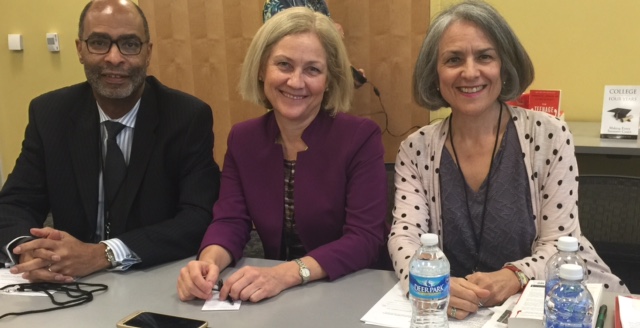
My panel discussion on the teenage mindset and higher education with Dr. Florence Jensen (The teenage Brain: Planning for Success in High School, College, and Beyond) and our moderator Ms. Elizabeth Benedict.


Dr. Granville M. Sawyer, Jr. Appears on The Thornton Business Hour Wednesday, January 20, 11:00 AM, WOL 1450 AM

Pat Thornton
I’ll be the guest of Pat Thornton, on her radio show, The Thornton Business Hour on WOL 1450 AM tomorrow January 20th at 11:00. You can also listen to the live stream at  http://woldcnews.newsone.com/ if you are outside of the listening area.

Pat and I will be talking about how to earn a college degree in less time with less stress for less money.  If you would like to leave a comment or a question that you would like for me to answer during the show please do so in the comments section below and tag it #ThorntonBusinessHour.

Talking Good Talk

2163137656_ef891f5c03_z
©: Rashida S. Mar b. on Flicker

In my last post, Strong Shoulders, I talked about the importance of having family and mentors who shape a young person’s life from birth. I was blessed to have people like this in my life. The first one I want to tell you about is a friend of the my family we called, The Bishop. He was not a man of the cloth as the name suggests and I’m not sure how he got this nickname but that’s what my father, who was his lifelong friend, called him. The Bishop was known for his sage advice and one day, he  told me,

“Granville, be grateful in your life if you can have three friends – your mother, your father and one other person.”

I am grateful that for more than fifty years, I  had, my mother and father in my life, guiding, supporting and encouraging me. They are the ones who helped me learn how to think and how to express myself. As long as we lived at home, they  my sister and me to be home for dinner six days a week – Sunday through Friday. Saturday you were on your own and that helped me  learn to cook to eat on the weekend!  However, each night we had a family dinner, we would finish the meal and then do what I call, “talk some good talk”. There were no restrictions on what we could talk about or  who could talk. All comments were taken seriously and responded to critically. Not that what was said was criticized but that meant that if you didn’t have something substantive to say, you  listened and learned until,  then you talked. I learned so much about people and the world at that dinner table. As I approached adulthood, the discussions became more important to me than the meals. I always learned something.

My wife and I had the same rules in our house – home for dinner six days a week for good food and good talk. Our friends and our daughters’ friends were always welcome to join us for dinner and conversation – around our table, everyone was family. My daughters who are now 25 and 32, one with children of her own, still say how much they enjoyed being able to talk with us about anything and, to some extent, reconnect at the end of each day.

My mother use to say that you can’t make the world safe for your kids you have to make your kids safe for the world. I think talking good talk at dinner is a great way to do that. Even though I can’t be with them at dinner, I take every opportunity to talk some good talk with my students in my roles as teach and mentor. I believe this can be just as important to student success as doing well in the classroom.

Wax On – Wax Off

Wax On Wax OffI was working with one of my MBA students to come up with a strategy for a test she had to pass to get her degree. She had previously failed this exam and figured the best strategy was to work more problems because the quantitative part of the test is what did her in. I told her that rather than working more problems she should put together a set of several problems that she knew would cover every type of problem that could be on the exam. She didn’t understand how identifying problems could be more important than working problems correctly.

“Have you ever seen the movie, The Karate Kid,” I asked her.

“Sure,” she replied.

“Do you remember when Ralph Machio’s character, Daniel, met Pat Morita’s character, Miyagi? What did Miyagi tell Daniel to do?”

“That was the best part of the movie! He told him to put wax on junked cars and to polish them – ‘Wax on – Wax off’,” she said demonstrating the process with her hands.

“That’s exactly right. Wax on – Wax off was the process Daniel needed to develop important defensive skills in karate even though he didn’t know it at first. Assembling a set of problems to work by correctly identifying and classifying each one is the most important step in learning how to solve any problem,” I said. “Because, if you can’t figure out what kind of problem it is, you surely can’t work it correctly. Wax on – Wax off. In the movie, doing this helped Daniel prepare to be successful in his karate matches, assembling your problem set will help you be prepared for whatever problems will be on the test next time,  even if it’s not obvious to you now.”

The smile on her face told me that she did know now. She knew the key to doing better on the test because identifying problems correctly was what she had trouble doing.

“Thanks so much, Dr. Sawyer, this has been a big help,” she said as she left my office, “I’ll remember, ’Wax on – Wax off.’”

GradeUP! Challenge #14: Knowing The Art Of No-ing

When to say noMillions of you are headed back to campus for the final weeks of the semester. During the first part of the semester you may have experienced how challenging time management and staying focused is, and will be, throughout your college careers. Through personal experience and conversations with my students, I’ve learned that mastering the skill of setting priorities and learning how to say “No,” can help you manage your time and sharpen your focus with great results. How well you deal with requests from other people for your time and effort will determine how successful you are at staying on course to graduation. This is especially true for if you’re doing well in school. Everyone wants a bit of your brilliance so you have to be careful not to burn yourself out.

Jill, a student of mine who was doing well came to see me just before the end of last semester. She flopped down in a chair in front of my desk, exhausted and stressed.

“I just can’t keep up with everything. It’s just too much,” she said. “I’m taking 15 hours to stay on track to graduate in four years, it takes a lot of time to do well in all my classes. I’ve made many friends that I like to go out with a lot. Then there are extracurricular activities I’d like to be involved in. There just isn’t enough time for everything I need to do, want to do or other people want me to do. Now, I don’t know what to do. ”

I told Jill, “I understand. I’ve got more to do than time to do it as well. Each activity or person outside of your course work wants just a little bit of your time but all of those little bits add up to more time than you have to give. The first thing you must remember is that your classes comes first. That is your priority; it is what you’re in college and paying for. Your education ensures your future. Plan any other activities around that fact. During each semester, I want you to plan each week in the semester by what you need to get done in your classes; then refer to that plan before committing to anything else. You’ll see right away which weeks your study load will be lighter than others – those are times you’ll have more time to play. You’ll know in advance when you’ve got two papers due, a research project and an exam, that’s when you’ll  have to say ‘no’ to any one and anything that tries to knock you off track.”

“That’s easier said than done,” Jill said “my friends can be pretty persistent, sometime they wear me down.”

“Then you’re going to have to learn how to say “no,” empathetically or emphatically.”

“What does that mean?” Jill asked.

“The empathetic no lets your friends down easy, ‘I’d love to go with you but I just can’t. I know you’re going to have a great time and I really wish I could be with you but I have to put this time in to pass this class.’ The emphatic no is just NO – you pull this out when the empathetic no doesn’t work.”

Jill laughed, “I’m going to have to use the emphatic no a lot.”

“Not necessarily,” I said. “The beauty of having your study schedule mapped for the semester the way I suggested, is that you can actually see where you can move some things around so that you can do other things, and still get everything done. That’s knowing when and how to say no.”

“I’m going to use this,” Jill said. “Thanks, Dr. Sawyer! Or should I call you, “Dr. Know.”

“Is that ‘k-n-o-w’ or ‘n-o,’” I asked.

“Both,” she said as she left my office smiling.